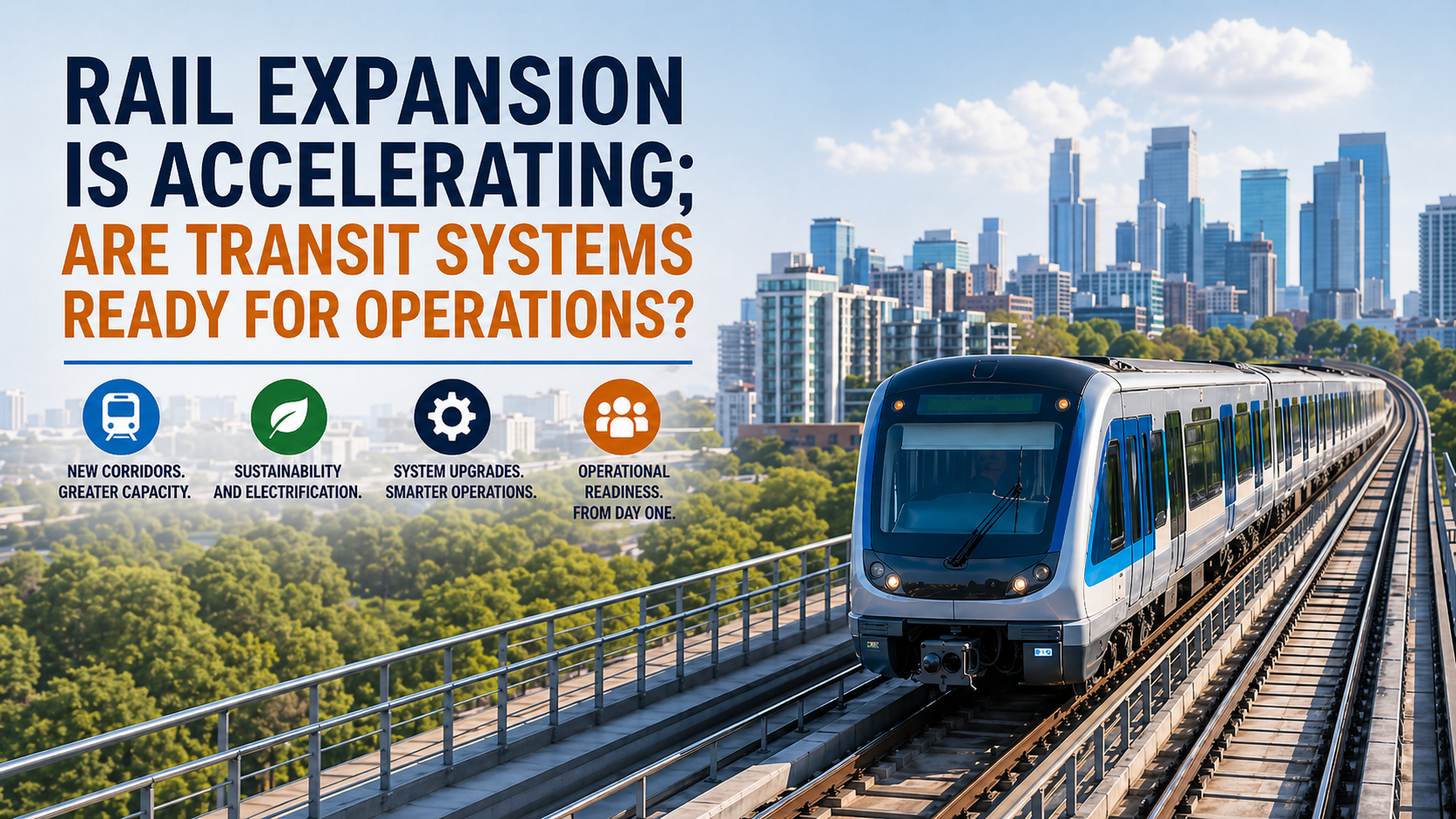
Across North America and globally, rail expansion is no longer a long-term vision, it is actively underway. Billions in infrastructure funding, sustainability initiatives, and urban mobility demands are driving the rapid development of new rail lines, system upgrades, and fleet modernization efforts.
But while expansion projects often focus on construction milestones and vehicle procurement, operational readiness is frequently underestimated. The question has become: can we operate it effectively from day one?
Growth of Rail Expansion
Transit agencies are experiencing unprecedented growth fueled by federal investment programs, state-level infrastructure initiatives, and increasing public demand for reliable, low-emission transportation.
Major expansion trends include:
- New commuter and light rail corridors
- High-speed rail development initiatives
- Electrification and sustainability upgrades
- Modernization of aging infrastructure
While these projects promise increased capacity and improved service, they also introduce complexity. Each new mile of track, each new vehicle, and each system upgrade expands the operational footprint that agencies must support.
Challenges of Operational Readiness
Operational readiness is where many expansion projects encounter friction. It is not just about having infrastructure in place; it is about ensuring that people, processes, and systems are fully prepared to support daily operations.
Common challenges include:
- Misalignment between project delivery and operational teams
- Incomplete or inconsistent technical documentation
- Insufficient time allocated for training and onboarding
- Integration issues between legacy and new systems
- Compressed timelines leading to rushed deployment
Without addressing these areas early, agencies risk delays, safety concerns, and inefficiencies that can persist long after launch.
Fleet Transitions
One of the most complex aspects of rail expansion is transitioning to new or upgraded fleets. Whether introducing electric multiple units, hybrid locomotives, or entirely new vehicle platforms, agencies must manage both technical and operational change simultaneously.
Key considerations include:
- Maintaining continuity of service during phased rollouts
- Supporting mixed fleets, including legacy and new vehicles
- Adapting maintenance procedures and schedules
- Ensuring parts, tooling, and diagnostic systems are aligned
- Training operators and technicians on new technologies
Fleet transitions are operational transformations that require coordinated planning and execution.
Documentation and Training
At the core of operational readiness lies clear, accurate, and accessible technical documentation. Without it, even the most advanced systems can become difficult to operate and maintain effectively.
Critical documentation components include:
- Operations manuals
- Maintenance manuals
- Troubleshooting guides
- Safety procedures
- Interactive Electronic Technical Manuals (IETMs)
Equally important is training. Personnel must not only understand new systems, but be confident in applying that knowledge in real-world scenarios.
Best practices include:
- Role-based training programs for operators, maintainers, and engineers
- Integration of documentation into training workflows
- Use of digital, interactive formats for faster knowledge transfer
- Continuous updates aligned with system changes
When documentation and training are treated as strategic assets, not afterthoughts, agencies can significantly improve readiness and long-term performance.
Lifecycle Support
Operational readiness evolves throughout the lifecycle of the asset. Lifecycle support ensures that systems remain safe, efficient, and compliant over time.
Lifecycle support includes:
- Ongoing updates to technical documentation
- Configuration management and version control
- Continuous training and knowledge retention
- Support for upgrades, retrofits, and system modifications
- Alignment with standards such as S1000D and ISO 9001:2015
As rail systems grow more complex, lifecycle support becomes essential to sustaining operational excellence and protecting long-term investments.
Rail expansion is accelerating, but success is no longer defined by construction alone. True success lies in operational readiness: the ability to seamlessly transition from project delivery to daily operations.
By prioritizing documentation, training, and lifecycle support alongside infrastructure development, transit agencies can ensure that their systems are built and fully prepared to perform.