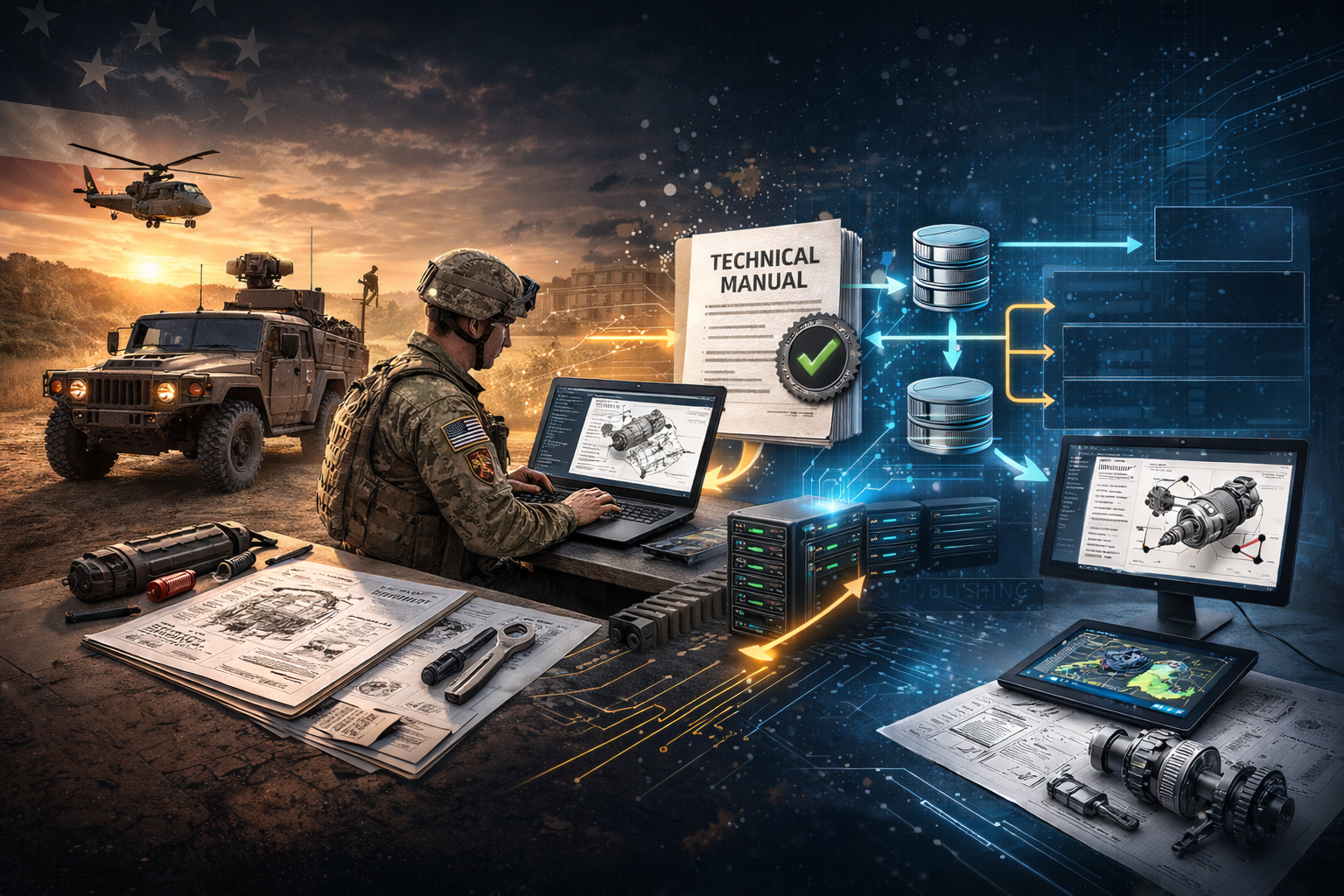
Technical manuals are mission-critical assets for the U.S. Army. They support safe operation, effective maintenance, training, and long-term sustainment of complex systems in demanding environments. To ensure consistency, interoperability, and lifecycle value, the Army requires many technical manuals to be developed in accordance with MIL-STD-40051. This is the governing specification for Army technical manual content and structure, covering operation and maintenance instructions for all maintenance levels up through Depot level.
Understanding why this standard exists and what it takes to comply with it is essential for manufacturers delivering equipment to the Army.
Why the U.S. Army Uses a Military Standard
The Army fields thousands of different systems across decades of service life, often maintained by multiple units, depots, and contractors. A military standard provides:
- Consistency across programs – Manuals written to a common standard reduce ambiguity and allow maintainers to move between systems with minimal retraining. This also includes conformity of style and format, taking the guesswork out of manual development.
- Safety and reliability – Standardized warnings, cautions, procedures, and formatting reduce the risk of maintenance errors by ensuring important information is easily and quickly identifiable.
- Interoperability – Manuals must integrate with Army logistics, training, and sustainment systems.
- Lifecycle support – Army systems are often supported for 20–40 years; documentation must be maintainable, updatable, and reusable over time.
MIL-STD-40051 ensures that technical manuals are not just readable documents for the intended audience, but structured data products that can evolve with the system they support.
The Role of XML in MIL-STD-40051
A core requirement of MIL-STD-40051 is the use of XML-based tagging to structure technical manual content. The XML is produced using Document Type Definitions (DTDs) and associated Stylesheets provided by the government in accordance with the contracted MIL-STD-40051 revision level.
XML tagging enables:
- Content reuse – Procedures, warnings, parts data, and descriptions can easily be reused across multiple manuals and platforms.
- Configuration control – Changes can be tracked, validated, and applied consistently across revisions.
- Multiple outputs from one source – A single XML data set can generate content in various forms as needed, such as PDF manuals and Interactive Electronic Technical Manuals (IETMs).
- System integration – XML allows manuals to interface with logistics systems, provisioning data, training, and maintenance management tools.
- Long-term data survivability – Unlike proprietary word-processing formats, XML remains usable as tools and platforms change over time.
Unlike static documents, XML turns a technical manual into a structured, authoritative data source.
Interactive Authoring and Display Software (IADS)
An essential component of modern Army technical manuals is the use of Interactive Authoring and Display Software (IADS). IADS is designed to author, manage, and publish XML-based technical manual content in compliance with MIL-STD-40051 and related Army requirements.
What Is IADS and Why It Matters
IADS provides a single, controlled environment for:
- Authoring technical content in structured XML
- Managing illustrations, parts data, and multimedia
- Enforcing business rules and schema validation
- Publishing outputs such as IETM packages and PDFs from a common data source
By using IADS, the Army ensures that technical manuals are compliant at delivery and maintainable throughout the system’s lifecycle.
Supporting IETMs and Digital Sustainment
IADS is foundational to the Army’s shift toward IETMs. When content is authored correctly within an IADS package:
- Procedures can be dynamically displayed and filtered
- Linked data (tools, parts, warnings) is always current
- Updates can be deployed without rewriting entire manuals
- Content can be reused across platforms and systems
This directly supports faster maintenance, improved accuracy, and reduced lifecycle costs.
Our Experience with IADS Development
We have experience working within Army-approved IADS environments and understand how to develop content that fully leverages their capabilities. Our team:
- Authors and validates XML directly in IADS
- Structures data to support reuse, configuration control, and future growth
- Ensures any XML document is compatible with Army IETM viewers, helping to meet delivery requirements and ensure data is optimized for long-term use
- Supports transitions from legacy manuals into IADS-managed data sets
Why Manufacturers Should Use an Experienced Technical Manual Firm
For manufacturers, MIL-STD-40051 compliance is often underestimated. Additionally, writing accurate technical content is only part of the challenge; structuring that content correctly in XML, creating a well-formed, optimized XML document, and aligning it with Army requirements is equally critical.
Deep Knowledge of the Standard
MIL-STD-40051 has specific rules for content organization, format requirements, warnings, task sequencing, and metadata. Firms with prior Army experience understand how to interpret and apply the standard correctly, which in turn avoids costly rework during government reviews.
Proven XML Authoring Expertise
Authoring in XML is fundamentally different from writing in Word. An experienced firm:
- Applies the correct XML schemas and tagging rules to create a well formed, 40051-compliant document
- Ensures content validates cleanly
- Structures data for reuse, updates, and future IETM deployment
- Is experienced with using various DTDs and Stylesheets and can utilize them efficiently to fulfill customer needs
Faster Reviews and Fewer Rejections
Government technical manual reviews are exacting. Manuals that do not conform to the standard, especially at the XML level, are often rejected or returned with extensive comments. Experienced firms know what reviewers expect and how to meet those expectations efficiently. Utilizing a firm with XML expertise helps avoid wasting time on unnecessary issues with conforming to DTD/MIL-STD/XML practices, allowing for more focus on technical matter.
Reduced Lifecycle Costs
Well-structured XML manuals are easier and less expensive to update, revise, and repurpose over the life of the system. XML allows for informational fields to be applied throughout the content, with updates applying automatically everywhere they appear. This reduces sustainment costs and supports future upgrades or modifications.
Focus for the Manufacturer
Outsourcing manual development allows manufacturers to focus on engineering, production, and delivery while ensuring documentation is compliant, accurate, and delivered on schedule.
Supporting the Army’s Mission Through Better Documentation
MIL-STD-40051 exists to ensure that technical manuals support readiness, safety, and sustainment across the Army’s diverse equipment portfolio. Compliance is a contractual requirement, and it directly impacts maintainability and operational effectiveness in the field.
For manufacturers, partnering with a technical manual firm experienced in MIL-STD-40051 writing and XML tagging is the most reliable way to deliver compliant manuals, reduce risk, and support the Army throughout the system’s lifecycle.
High-quality technical documentation is more than paperwork; it is an operational asset.