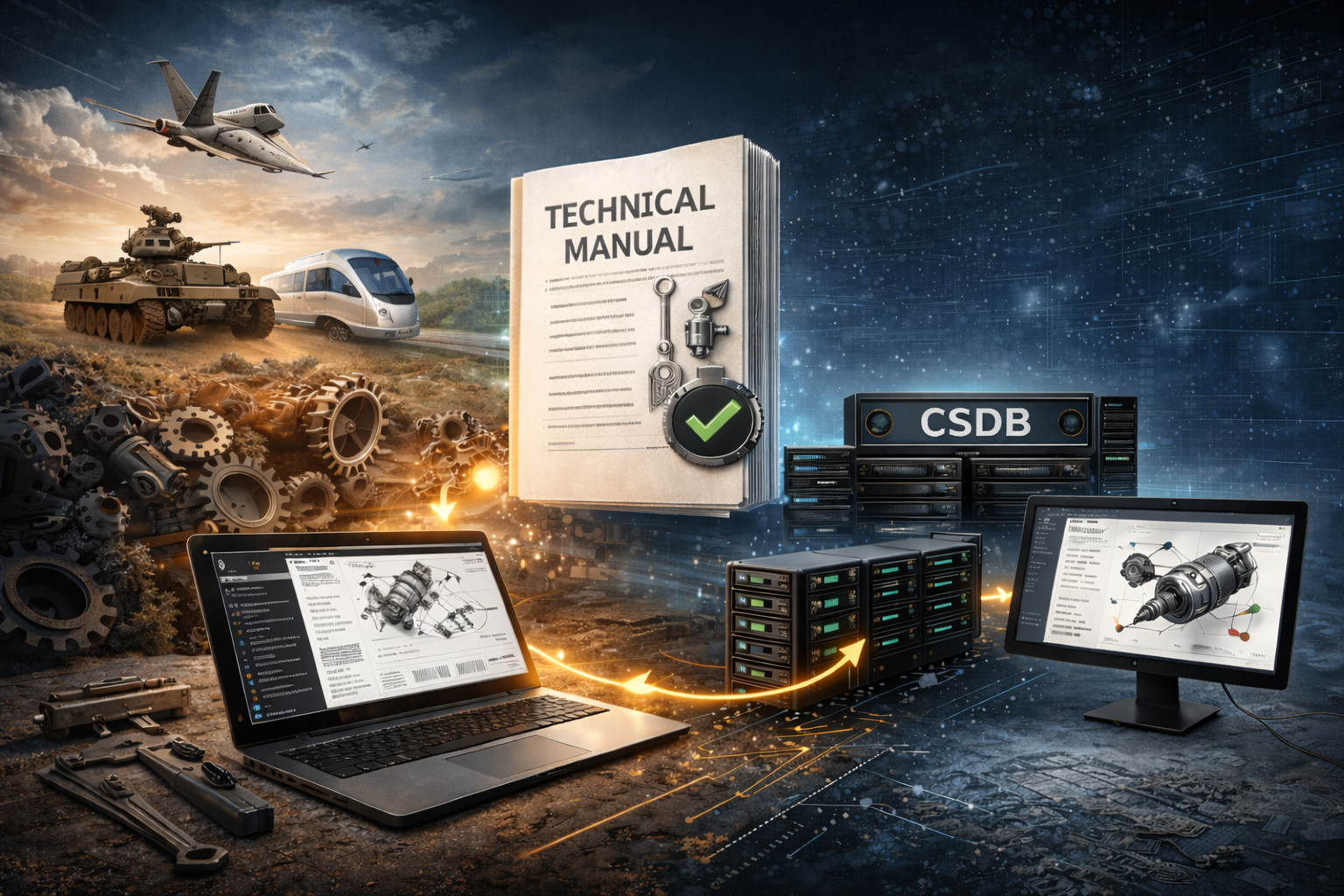
As technical systems become more complex and more regulated, the way technical manuals are written, managed, and delivered matters more than ever. For manufacturers in defense, aerospace, rail, and other asset-intensive industries, the S1000D specification has become the global standard for developing and publishing technical documentation.
S1000D is a structured, data-driven approach to technical information that requires the right tools, processes, and experience to implement successfully.
Why S1000D Is Used
S1000D was developed to solve long-standing challenges in technical documentation: duplication of content, inconsistent updates, and difficulty maintaining configuration control across complex systems. Instead of treating manuals as static books, S1000D treats technical information as modular data that can be reused, updated, and published in multiple ways.
Key benefits of S1000D include:
- Modular content reuse across platforms, variants, and programs
- Improved accuracy and consistency through structured authoring
- Reduced lifecycle costs by minimizing duplicated effort
- Easier updates and revisions when engineering changes occur
- Interoperability across organizations, suppliers, and tools
For manufacturers supporting long-life assets, S1000D enables documentation to evolve alongside the system, without constantly rewriting manuals from scratch.
Why S1000D Requires XML Tagging
At the heart of S1000D is XML-based structured authoring. Content is not written as free-form text, but as data modules tagged to a defined schema (DTD or XSD). Each element, procedure, warning, part data, figure, applicability, and metadata is explicitly identified and validated.
This XML tagging is what allows S1000D content to be:
- Machine-readable and searchable
- Reusable across publications
- Automatically validated for compliance
- Published to multiple outputs (PDF, IETM, HTML, etc.)
- Integrated with logistics, maintenance, and configuration systems
Without proper XML tagging, content cannot be reliably reused, validated, or exchanged, undermining the very reasons S1000D exists.
Why a CSDB Is Essential
A Common Source Database (CSDB) is the backbone of any compliant S1000D implementation. The CSDB is not just a file repository; it is a controlled environment that manages data modules, metadata, versioning, applicability, and relationships between content objects.
An effective CSDB enables:
- Centralized storage of all S1000D data modules
- Strict configuration and change control
- Traceability between engineering data and technical content
- Controlled reuse across manuals and platforms
- Automated publishing and validation
Without a CSDB, organizations are forced to manage XML manually, increasing risk, inefficiency, and non-compliance.
Why Manufacturers Should Work with an Experienced S1000D Technical Manual Firm
Implementing S1000D successfully requires experience in structured authoring, XML tagging, CSDB configuration, and publication workflows, along with a deep understanding of how maintainers actually use the information.
Manufacturers benefit from partnering with an experienced S1000D technical manual firm because:
- Writers understand how to author content correctly at the data-module level
- XML tagging is applied consistently and validated from the start
- Business rules, BREX, and project-specific requirements are enforced
- Content is written for reuse, not just initial delivery
- CSDB workflows are aligned with real-world engineering and maintenance processes
This reduces program risk, shortens schedules, and avoids costly rework late in the project.
Our CSDB: Built, Proven, and Tailorable
Our organization has a fully developed, S1000D-compliant CSDB that meets the specification requirements out of the box. Rather than reinventing a database for each program, our CSDB is tailored to project-specific needs, including customer rules, naming conventions, data standards, and publication outputs.
Key capabilities include:
- A writer-friendly GUI that allows authors to work directly within the CSDB
- Automated generation of XML-tagged content compliant with S1000D
- Output to specified DTDs and schemas, not limited to S1000D
- Built-in validation and configuration control
- Support for multiple publication formats and delivery platforms
This approach allows manufacturers to gain the benefits of S1000D quickly, without the time, cost, and risk of building and maintaining their own CSDB infrastructure.
Turning S1000D into a Competitive Advantage
When implemented correctly, S1000D is a strategic advantage. Structured, reusable technical information lowers lifecycle costs, improves fleet availability, and ensures maintainers have the right information at the right time.
By partnering with a technical manual firm experienced in S1000D authoring, XML tagging, and CSDB management, manufacturers can focus on building great products while trusting their technical documentation to a system designed for accuracy, efficiency, and long-term sustainment.